
GMCMI is a volunteer-run club celebrating the classic GMC Motorhome: sharing technical knowledge, social rallies, and an international community of owners and enthusiasts.
.svg)
.svg)


©2026 GMC Motorhomes International
Privacy Policy
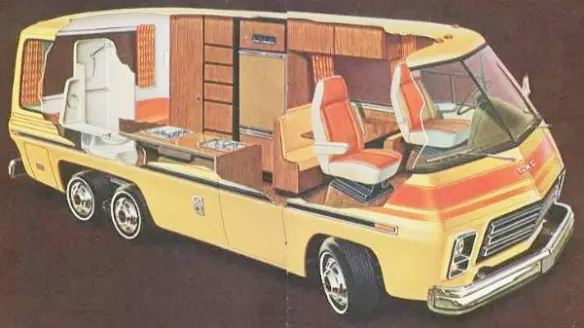
When GMC introduced its motorhome in 1973, the recreational vehicle industry looked very different than it does today. Most motorhomes were built on truck chassis, tall and boxy, designed more for function than form. They were capable, but hardly graceful. Then GMC did something unexpected: it built a motorhome from the ground up — not as a truck conversion, but as a purpose-built touring coach.
What emerged was one of the most distinctive and forward-thinking motorhomes ever produced.
The GMC Motorhome was built on a modified front-wheel-drive platform derived from the Oldsmobile Toronado. That decision alone set it apart. By eliminating the traditional rear driveshaft and live axle, GMC engineers were able to lower the floor dramatically. The result? A sleek, aerodynamic profile that still turns heads nearly fifty years later.
Its low stance wasn’t just cosmetic. It improved handling, reduced wind resistance, and made the coach feel more stable on the highway. Independent front suspension and tandem rear axles further enhanced ride quality. In many ways, the GMC drove more like a large touring car than a traditional motorhome.
At 23 or 26 feet in length depending on the model, it was compact compared to many modern coaches — yet thoughtfully designed inside. The interiors featured creative layouts, molded fiberglass construction, and panoramic windows that made the living space feel open and bright.
In short, it didn’t look like anything else on the road.
And it still doesn’t.
Between 1973 and 1978, GMC produced approximately 12,921 motorhomes.
To put that into perspective, many modern RV manufacturers produce that many units in a single year. The GMC was only manufactured for six model years before production ceased in 1978 due to corporate restructuring and shifting priorities within General Motors.
No direct successor was ever produced.
That makes every surviving GMC Motorhome a limited-edition piece of history.
Of course, not all 12,921 coaches are still on the road today. Time, weather, accidents, and neglect have taken their toll. Yet what is remarkable is how many remain operational. Thanks to passionate owners, strong parts interchange knowledge, and dedicated clubs like GMCMI, thousands of these coaches are still traveling highways across North America.
For a vehicle approaching its 50th anniversary, that survival rate is extraordinary.
The GMC Motorhome has something many RVs never develop: a culture.
Owners don’t simply buy a GMC for transportation. They adopt a lifestyle centered around preservation, restoration, mechanical understanding, and community.
Some coaches remain close to factory original, lovingly maintained in period-correct condition. Others have been modernized with fuel injection conversions, upgraded suspensions, solar power systems, lithium batteries, redesigned interiors, and even complete custom restorations. The platform is incredibly adaptable.
But regardless of modification level, every owner shares something in common: respect for the engineering and design that made the coach possible.
At rallies across the country, it’s common to see rows of GMCs — each one slightly different, each one reflecting the personality of its owner. Conversations naturally drift toward technical improvements, travel stories, and the subtle design details that make these coaches special.
It’s not unusual for curious campground neighbors to wander over and ask, “What year is that?” or “Who makes it?” The answer often leads to a long conversation about history, innovation, and why these coaches are still on the road decades later.
With each passing year, the GMC Motorhome becomes rarer — not because interest is fading, but because time continues to move forward.
The newest GMC Motorhome is now approaching 50 years old. That milestone alone places it firmly in classic vehicle territory. As collector interest grows in vintage automobiles, appreciation for unique and historically significant RVs is also increasing.
But unlike a car locked away in a climate-controlled garage, the GMC Motorhome was designed to travel. Its legacy isn’t static — it’s rolling.
Owners continue to cross the country in them. Families continue to create memories in them. And clubs like GMCMI continue to preserve the knowledge necessary to keep them operating safely and reliably.
The GMC Motorhome represents a moment in time when a major manufacturer was willing to innovate boldly. It blended automotive engineering with recreational travel in a way that was ahead of its era.
Today, it represents something equally important: stewardship.
Every maintained GMC Motorhome is proof that thoughtful engineering, combined with passionate ownership and strong community support, can extend the life of a vehicle far beyond expectations.
For many owners, the rarity is part of the appeal. It’s knowing that you’re driving something unique. It’s the wave from another GMC owner passing in the opposite direction. It’s the instant camaraderie at a fuel station when someone recognizes the silhouette.
These coaches are rare in number — but rich in legacy.
And as long as they continue to roll down America’s highways, that legacy lives on.
GMCMI is a volunteer-run club celebrating the classic GMC Motorhome: sharing technical knowledge, social rallies, and an international community of owners and enthusiasts.