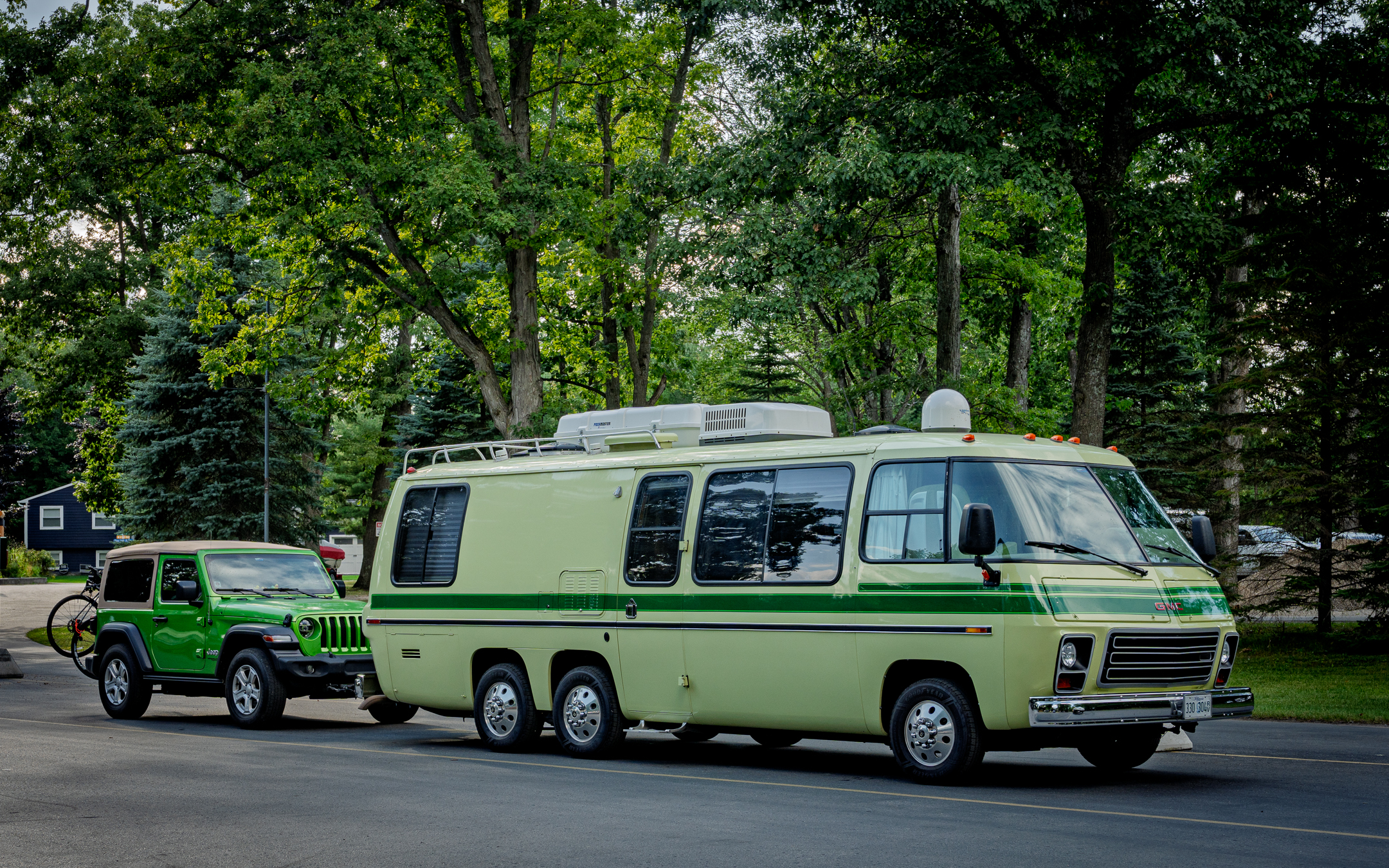

The complete story of America's most innovative motorhome, built by General Motors from 1973 to 1978.
In the late 1960s and early 1970s, the motorized RV market was growing rapidly — but it consisted mostly of truck chassis supplied to about 50 different coach builders, each manufacturing their own version of what a motorhome should be. General Motors saw an opportunity to do something fundamentally different.
The concept was audacious: a motorhome built from the ground up using the front-wheel-drive powertrain from the Oldsmobile Toronado — a 455 cubic inch engine, a 425 Hydramatic transmission, and a unique tandem rear-wheel suspension using a hydro-pneumatic air spring. This low-profile design gave the GMC Motorhome a lower center of gravity, better handling, and more interior living space than anything the industry had seen.
Development work was rigorous. A prototype called the 'Pie Wagon' — a modified van body on the new chassis — was used to demonstrate the superior handling to GM management. A 1/16th scale model was tested in the Guggenheim wind tunnel, achieving a coefficient of drag of just .310. The full-scale clay model, 26 feet long, may have been the largest GM ever produced. When completed, the exterior body and aluminum frame were bonded with 3M adhesive — a technique borrowed from aerospace engineering.
On January 3, 1973, at Anaheim Stadium in California, the GMC Motorhome was introduced to the press. Over 100 journalists watched demonstrations and drove the coach themselves. News articles declared: 'GM Motor Home to set industry on its ear.' By March 1973, over 1,750 orders had been received. By June, backorders totaled 3,000 units with production running at nearly 20 units per day. The GMC Motorhome was produced in several distinct floor plans across its six-year run, including the Kingsley, Canyon Lands, Palm Beach, Eleganza II, Glenbrook, and Edgemont — as well as the Transmode (featuring a rear garage), the Royale (the flagship luxury model), and the Birchaven (a mid-length variant). Each floor plan offered a unique layout while sharing the same revolutionary front-wheel-drive chassis.
Total production: 12,921 motorhomes built across six model years.
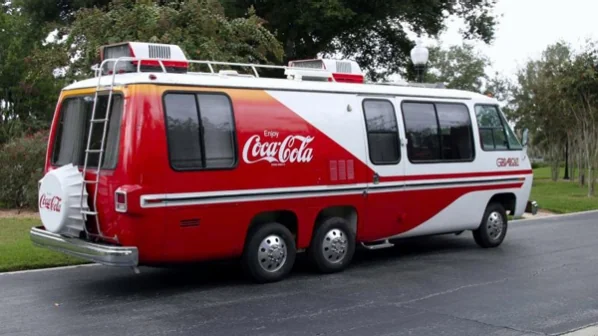
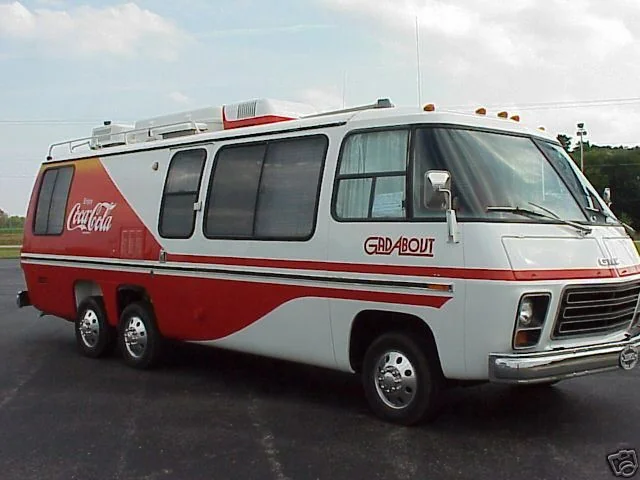
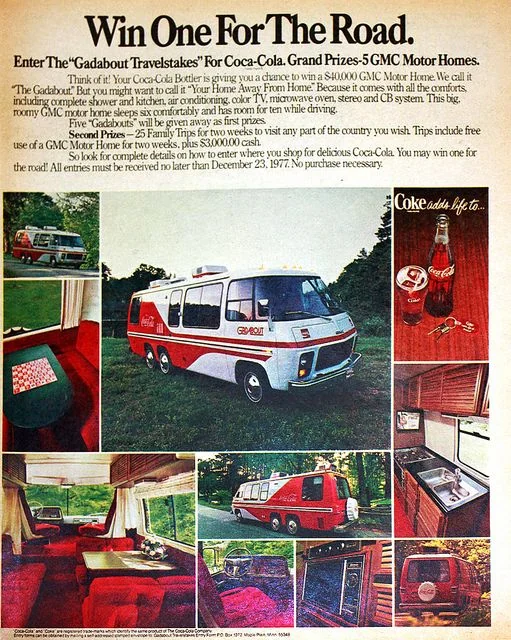
In 1977, one of the most unusual fleet vehicles in American history rolled off the GMC line: the Coca-Cola GadAbout. Fifty-five special Coca-Cola edition coaches were built — most in 1977, a few in 1978. The standard version wore Cameo White with a red horizontal stripe. But the GadAbout was something else entirely: exterior paint swept from Coca-Cola red up the coach sides, blending to yellow near the rear, with a bottle-cap-shaped spare tire cover at the back.
Inside, Coca-Cola red upholstery carried the theme throughout. The refrigerator door was graphically styled to look like a soda vending machine. A pewter plaque on the dash read: 'Coke adds life to…cruisin in a GadAbout.' Five GadAbouts were given away as first prizes in a Coca-Cola contest in December 1977. Twenty-five second-prize winners each received two weeks' use of a GMC Motorhome plus $3,000 cash.

On November 11, 1977, Robert W. Truxell, General Manager of GMC Truck and Coach, made an announcement that stunned the RV world: GMC would discontinue producing luxury MotorHomes and convert those plant facilities to expand truck operations. The official reason: 'to utilize production facilities more effectively for servicing growing truck demands.' GM's corporate downsizing had begun, and the halo vehicle that Alex Mair once compared to the Corvette was sacrificed for practicality.
Production continued through July 1978. The final 1,879 coaches rolled off the line in Pontiac, Michigan, capping a six-year run of 12,921 vehicles. But the story didn't end there. The GMC Motorhome's engineering excellence was so far ahead of its time that owners, mechanics, and enthusiasts continue to maintain, restore, and drive them today — over 50 years later. That legacy is why GMCMI exists.
"The GMC Motor Home was to GMC what the Corvette was to Chevrolet — its halo vehicle."
GMCMI is a volunteer-run club celebrating the classic GMC Motorhome: sharing technical knowledge, social rallies, and an international community of owners and enthusiasts.
.svg)
.svg)
.svg)